

Concepts are not descriptions.
They are the structures through which description becomes possible.
Each concept represents a mode of organization within the system - not isolated, but continuously interacting.
They are not meant to be read in sequence, but encountered.
Core Concepts - Advanced Topics
Concept Models

Plant - Insect: Externalized Intelligence
A stationary plant generates an internal simulation layer and externalizes parts of its functional logic into mobile insect agents.
The insect operates as an outsourced module of perception and action, while remaining semantically coupled to the plant through continuous feedback.

Shared Semantic Field
Plant and insect do not exist as separate entities, but operate within overlapping semantic fields.
Their interaction forms a shared “third space” in which perception, signaling, and action emerge as a unified system rather than as exchange between individuals.

Morphing Identity Structures
Between plant and insect, identity becomes fluid.
Mimicry is not deception, but a structural coupling process in which forms, behaviors, and meanings transition across biological boundaries, creating hybrid and unstable configurations.
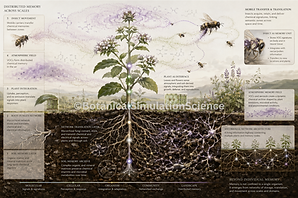
Distributed Memory Network
Memory is not stored in a single organism but circulates across plants, atmosphere, soil, and insects.
Chemical fields, bioelectric networks, and mobile agents form a layered architecture in which information is continuously transformed and redistributed.

Planetary Coupling System
Plant-based semantics extend beyond individual organisms into atmospheric and planetary scales.
Through insects and chemical interfaces, these systems shape environments and can even influence perception, enabling a form of “porting” between biological reality and expanded states of consciousness.